
New York Police Records
New York police records are maintained by law enforcement agencies at the state, county, and city level across all 62 counties. These records include incident reports, arrest reports, accident reports, and criminal investigation files. The Freedom of Information Law (FOIL) gives the public the right to request police records from any New York government agency. Requests can be filed online, by mail, or in person depending on the agency. The New York State Police, county sheriff offices, and municipal police departments each handle their own records. To search for New York police records, start with the agency that responded to the incident or made the arrest.
New York Police Records Overview
How to Request New York Police Records
Police records in New York are accessed through the Freedom of Information Law, known as FOIL. This law is found in Article 6, Sections 84 through 90 of the NYS Public Officers Law. It gives you the right to see records held by any state or local government agency. That includes police departments, sheriff offices, and state agencies. FOIL has been in place since 1974.
A "record" under FOIL covers a wide range of items. It includes reports, statements, memos, files, photos, maps, letters, and computer data. Basically, if a police agency made it or keeps it, you can ask for it. Some records have limits on what can be shared, but the law says access is the default. Agencies must explain in writing if they deny a request.
To file a FOIL request, put your request in writing. Many agencies now have online portals. The New York State Police accepts requests through a GovQA online form. You need to provide details like the incident number, date, location, and names of people involved. Be as specific as you can. The more detail you give, the faster the agency can find the right records. Under Public Officers Law Section 89, agencies must respond within five business days. They can grant access, deny the request with reasons, or send a note saying they need more time.
If you get a denial, you have the right to appeal within 30 days. The appeal goes to a designated officer within the agency. That officer has ten business days to respond. If the appeal fails, you can file a lawsuit within four months. The Committee on Open Government also issues advisory opinions on FOIL matters and can help resolve disputes.
New York State Police Records
The New York State Police maintain records for incidents they investigate across the state. Their Central Record Bureau at 1220 Washington Avenue, Building 22, Albany, NY 12226-2252 handles all records requests. You can call or submit a request through their online portal. Mail requests go to the same address, directed to the Central Record Bureau.
The fee for a State Police incident or investigation report is $15.00 per report under Public Officers Law Section 66-a. Extra pages cost $0.25 each for copies up to 9 by 14 inches. Digital media like CDs cost $3.00. Certified copies add $15.00. Photos cost $25.00 each. Online credit card payments carry a 2.99% service fee. Payment goes by check or money order to the "Superintendent of State Police."
You can also inspect records in person at State Police headquarters in Albany. Appointments are available on business days from 9:00 AM to 5:00 PM. The agency will let you know when records are ready and set up a time for you to come in.
The State Police keep several categories of records. These include administrative files, criminal information records, communications records, laboratory records, and pistol permit records. However, they do not hold all types of records. For driver history, contact the DMV. Criminal history record information goes through the Division of Criminal Justice Services (DCJS). Crime statistics and disposition of criminal cases are handled by other agencies as well.
Criminal History Records in New York
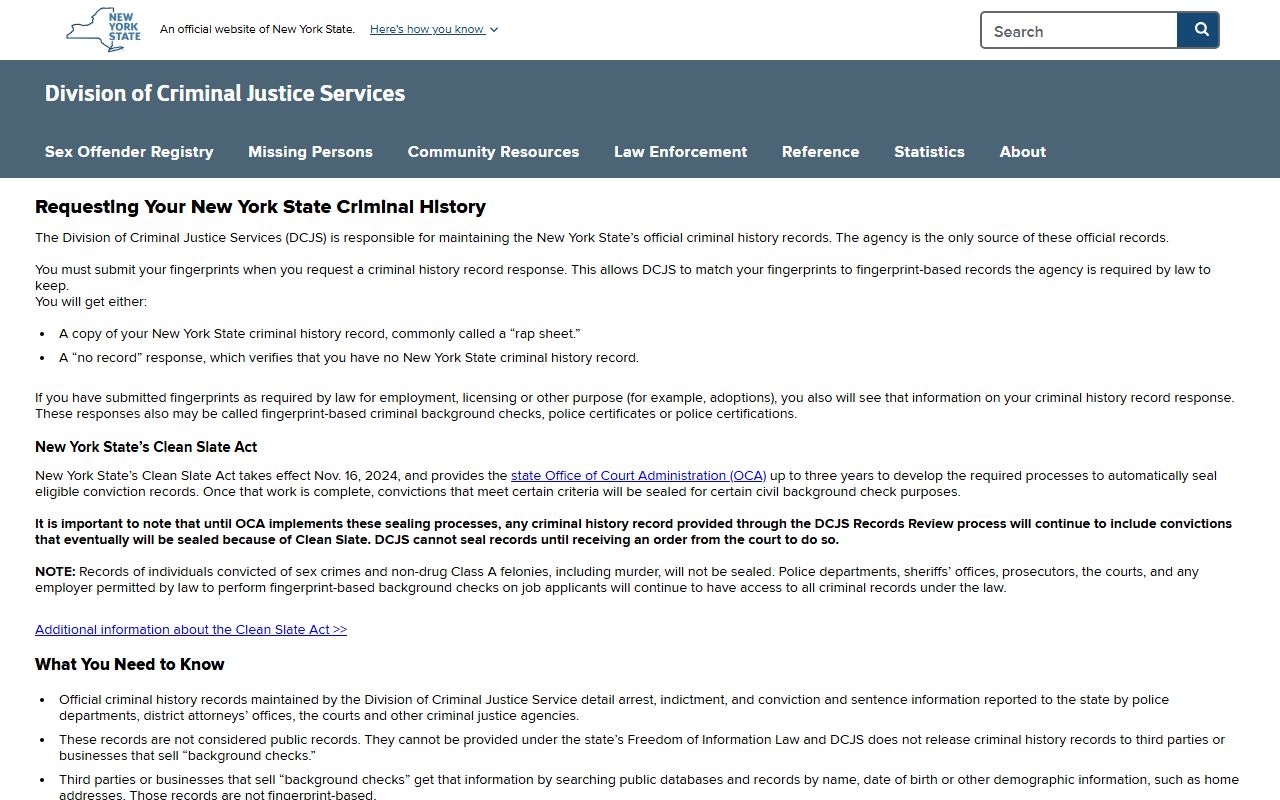
The Division of Criminal Justice Services (DCJS) is the only source for official New York State criminal history records. No other agency or third party can provide these. To get your own criminal history, you must submit fingerprints. DCJS matches them against their database and sends back either a rap sheet or a "no record" response.
These criminal history records are not public. They cannot be released under FOIL. DCJS does not give them to businesses that sell background checks. Third-party companies get their data from public court databases, not from DCJS. Two types of responses are available: unsuppressed (includes all records, even sealed ones) and suppressed (leaves out sealed items). Sealed records fall under CPL 160.50, 160.55, 160.58, 160.59, and 720.35.
New York's Clean Slate Act took effect on November 16, 2024. It directs the Office of Court Administration (OCA) to automatically seal certain old conviction records over the next three years. Convictions for sex crimes and non-drug Class A felonies like murder will not be sealed. Law enforcement agencies and courts will still have full access to all records regardless of sealing.
For questions about criminal history records, contact the DCJS Record Review Unit at 518-457-9847 or 518-485-7675, Monday through Friday from 8 AM to 4 PM. The mailing address is Record Review Unit, NYS Division of Criminal Justice Services, 80 South Swan St., 5th Floor, Albany, NY 12210. You can also email RecordReview@dcjs.ny.gov.
Police Records Through New York Courts
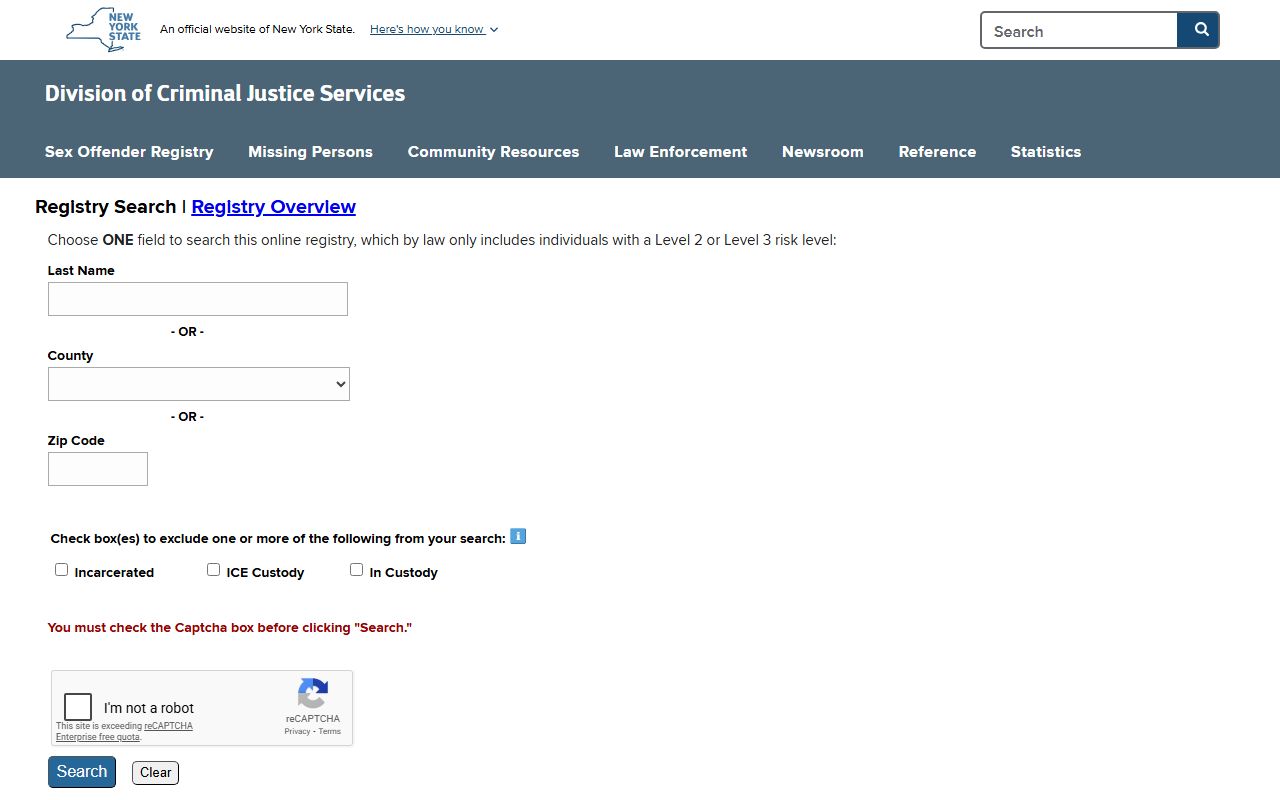
The eCourts WebCivil Supreme system gives access to civil case information in the Supreme Court of all 62 New York counties. You can search by party name, index number, or attorney. The system shows case details, scheduled appearances, and party information. It updates daily. For cases filed before electronic filing started in a given county, you need to visit the County Clerk in person.
The OCA Criminal History Record Search is a separate tool. It is a name-based statewide search that costs $95.00 per name. If no records come up, you still pay the fee. The search matches exact name and date of birth only. Processing takes about two weeks. OCA does not search for youthful offender records, as those are sealed.
WebCrims is the court system's database of pending criminal cases. It covers most county, city, district, and town courts. You can search by defendant name, case number, or attorney. The system shows charges, court dates, and case status. Sealed cases and juvenile matters do not appear. Some smaller courts may not have their data in the system yet. For cases not in WebCrims, contact the specific court clerk.
Fees for New York Police Records
Copy fees for police records in New York follow state guidelines. The standard rate is $0.25 per page for copies up to 9 by 14 inches. Agencies can charge the actual cost for larger items or other formats. If a request takes more than two hours of staff time, the agency may bill the hourly wage of the lowest-paid employee who can do the work.
State Police reports cost $15.00 per incident report. The OCA criminal history search runs $95.00 per name. DMV accident reports cost a $7.00 search fee plus $15.00 per report for online orders, or $10.00 plus $15.00 through the Records Request Navigator. Fees at county and city agencies vary slightly, but most follow the $0.25 per page standard set by Public Officers Law Section 87.
Note: Fees can change. Contact the specific agency before submitting your request to confirm current costs and accepted payment methods.
Other New York Police Records Databases
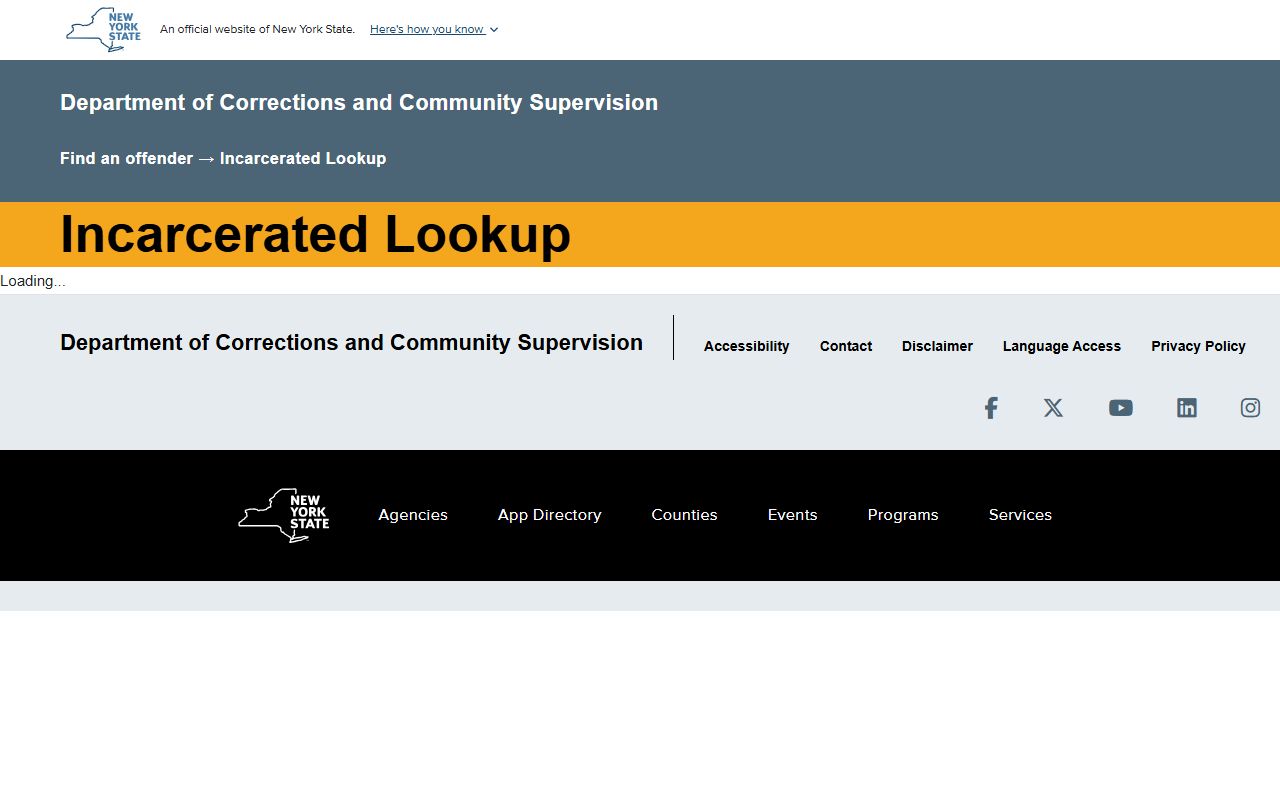
The New York Sex Offender Registry is run by DCJS. It lists offenders required to register under Correction Law Article 6-C. Level 2 and Level 3 offenders appear on the public website. Level 1 offender details can be obtained by contacting the local police or sheriff. You can search by name, address, or county. The registry provides photos, addresses, offense details, risk level, and vehicle information. A toll-free line at 1-800-262-3257 gives information about Level 2 and 3 offenders around the clock.
The DOCCS Incarcerated/Parolee Lookup covers people in state prison or on parole. The database shows name, date of birth, custody status, facility, and release dates. It updates daily. It does not include county jail inmates, probationers, or federal prisoners. For county jail information, contact the sheriff in that county.
The DMV Crash Report Sales Portal lets you order motor vehicle accident reports filed by police agencies statewide. Reports become available 14 to 30 days after an accident filed electronically, or 30 to 60 days for paper filings. You need a NY.gov ID to use the portal. Search by date, county, VIN, plate number, or driver license number. Purchased reports stay accessible for 7 calendar days.
What Police Records Are Exempt Under FOIL
Not all police records can be released. FOIL lists specific reasons an agency can deny a request. Records that would interfere with a law enforcement investigation or judicial proceeding can be withheld. The same goes for records that could deprive someone of a fair trial, reveal a confidential source, or show non-routine investigative techniques. If releasing a record could put someone in danger, the agency can hold it back.
Redacting is common with police records. The agency blacks out protected information while leaving the rest visible. Names of crime victims are generally not released. Court convictions are public, but juvenile records and court-ordered sealed records stay closed. Under Public Officers Law Section 87(2), agencies must explain which exemption applies when they deny access to a record. They must still release any parts of a record that are not exempt.
Browse New York Police Records by County
New York has 62 counties, each with a sheriff's office or police department that maintains police records. Some counties also have separate municipal police agencies. Select a county below to find local contact details and resources for police records in that area.
Police Records in Major New York Cities
Residents of major cities can request police records from their local police department or the county sheriff. Select a city below to find the right agency and learn how to request records.